How a Top‑20 Biopharma Unlocked $150M+ in Strategic Value by Reprioritizing Its Global Oncology Pipeline
Overview
In today's hyper‑competitive oncology landscape, portfolio clarity is no longer a luxury—it's a survival requirement. Biopharma organizations are under pressure to make faster, evidence‑backed decisions while navigating fragmented data, evolving treatment pathways, and rising R&D costs.
One top‑20 biopharma company faced this exact challenge. Despite significant capital deployed across multiple tumor types, leadership struggled with limited visibility into real‑world unmet needs and clinical adoption potential. Internal assumptions dominated decision‑making, slowing progress and obscuring high‑value opportunities.
What happened next demonstrates how AI‑driven intelligence—combined with deep human expertise—can reshape strategic outcomes.
The Situation
A top-20 biopharma company was managing a complex oncology pipeline across multiple tumor types, with significant capital deployed but limited decision clarity.
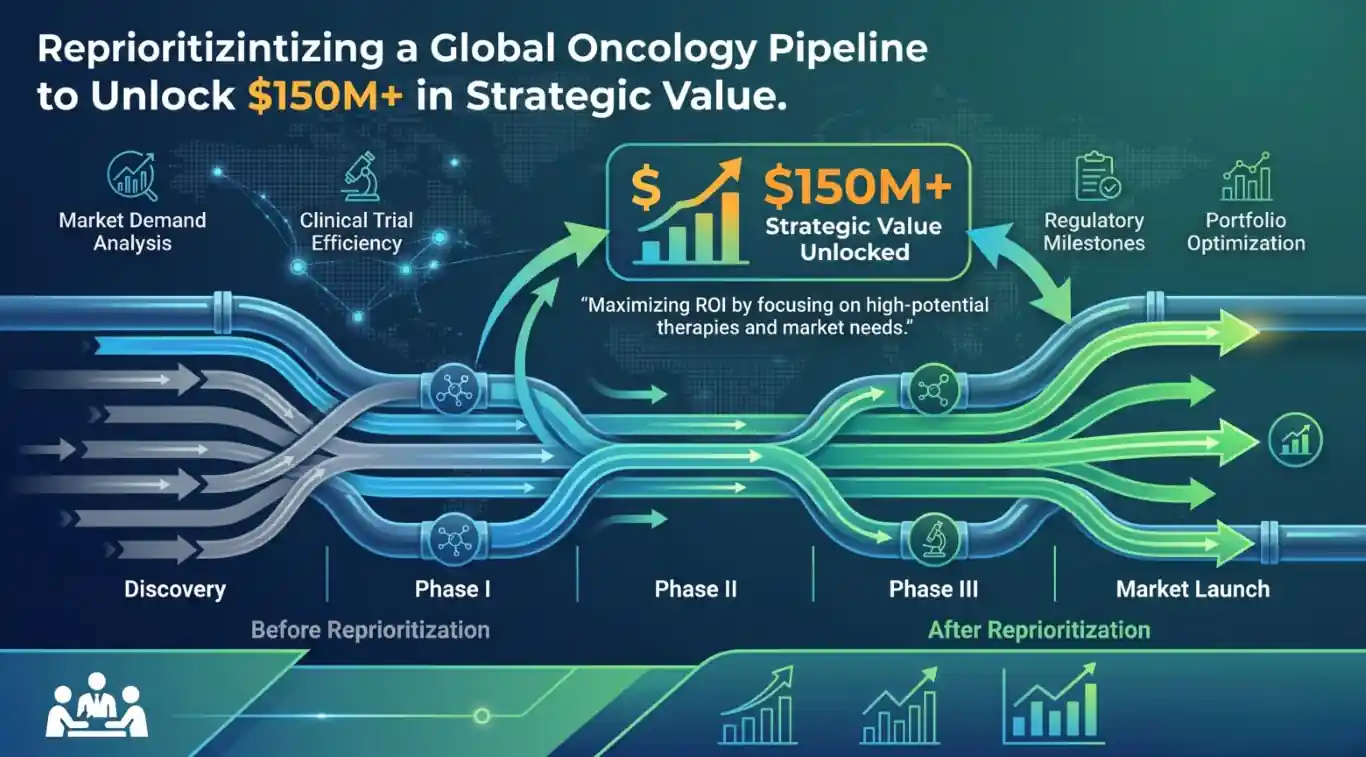
Case Summary
The team faced fragmented oncology insights and slow, assumption-led decisions. Apothium AI combined expert validation with AI-driven synthesis to prioritize high-potential indications and create leadership-ready clarity.
- Reallocated $150M+ toward higher-probability assets
- Reduced portfolio decision timelines by 40%
- Strengthened long-term pipeline ROI with better confidence
Frequently Asked Questions
Portfolio prioritization is the process of evaluating multiple drug candidates or indications and strategically allocating capital, resources, and timelines to those with the highest probability of clinical and commercial success. In oncology, this is especially complex given the number of tumor types, competitive pressures, and evolving treatment standards.
The company relied heavily on secondary research and internal assumptions rather than direct input from practicing oncologists. This created fragmented, siloed insights across tumor types with no unified real world validation layer—making it difficult for leadership to confidently reallocate capital or accelerate decisions.
ApoInsights activated a global panel of oncology experts to validate unmet needs, map real world treatment pathways, and surface overlooked clinical opportunities. It replaced assumption based decision making with evidence grounded in lived clinical reality across key markets.
ApoKynex transforms raw KOL (Key Opinion Leader) inputs into structured, leadership‑ready intelligence. It builds prioritization frameworks, benchmarks clinical differentiation against competing assets, and distills expert opinions into clear recommendations that accelerate strategic decisions.
Expert validated intelligence revealed that two previously deprioritized indications had significantly higher real‑world adoption potential than currently funded assets. This allowed leadership to redirect approximately $150M toward these higher‑probability opportunities—strengthening long‑term pipeline ROI and reducing wasted investment.
Yes. The Apothium AI model—combining AI‑driven synthesis with human expert validation—is designed to scale across therapy areas and pipeline stages. Whether a company is entering a new indication, assessing competitive positioning, or making capital allocation decisions, the same intelligence ecosystem applies.